

l

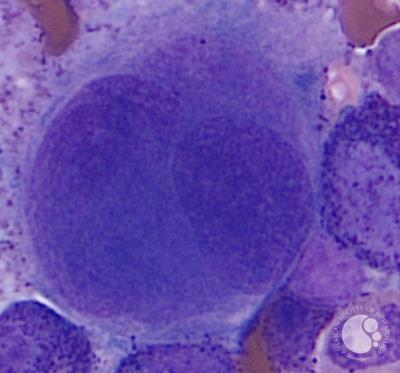
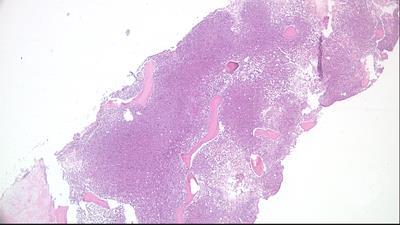
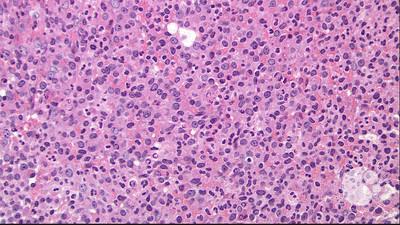
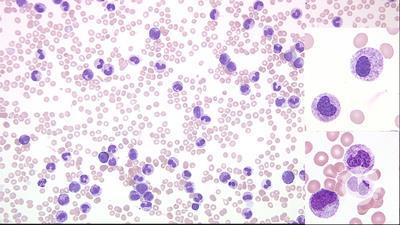
TP53-mutated AML with salmon-colored globules, a single Auer rod, pseudo–Chédiak-Higashi granules, and micronuclei
#00066190
Author: Zhaodong Xu; Nadia Medvedev
Category: Myeloid Neoplasms and acute leukemia (WHO 2016) > Myelodysplastic/myeloproliferative neoplasms (MDS/MPN)
Published Date: 01/31/2026
Category: Myeloid Neoplasms and acute leukemia (WHO 2016) > Myelodysplastic/myeloproliferative neoplasms (MDS/MPN)
Published Date: 01/31/2026
A 65-year-old woman presented with pancytopenia and circulating blasts. Peripheral blood showed a leukocyte count of 13.5 × 10⁹/L, a hemoglobin level of 8.6 g/dL, a platelet count of 51 × 109/L, and 29.6% blasts. Marrow aspirate revealed multilineage dysplasia and 77% blasts with a single Auer rod (black thin arrows), paranuclear hof, salmon-colored cytoplasmic globules (red triangles), pseudo–Chédiak-Higashi granules (red curved arrows), and micronuclei (black thick arrows) (panel A, May-Grünwald Giemsa stain, 100× lens objective). Flow cytometry showed high side-scatter blasts, CD34−/HLA-DR−/CD117+ (panel B)/CD33+/CD13+/variable CD15/CD64+/cMPO+. Biopsy illustrated sheets of blasts (panel C, hematoxylin and eosin stain, 50× lens objective) with CD117+/CMYC+ (panel C inset [left], 50× lens objective)/TP53+ (panel C inset [right], 50× lens objective). Fluorescence in situ hybridization for PML::RARA was negative. Cytogenetics/optical genome mapping showed a complex karyotype (CK): 45,XX,-4,-5,add(7)(q32),-8,-17,?der(19)t(17;19)(q12;p13.2),+3mar,1-6dmin[9] with chromothripsis of chromosome 4 and MYC (8q24.21) amplification (panel D). Next-generation sequencing identified a TP53 mutation (variant allele frequency [VAF], 46.4%). A diagnosis of acute myeloid leukemia (AML) with mutated TP53 per International Consensus Classification (ICC) or AML, myelodysplasia-related with TP53 mutation noted per WHO-HAEM5 (5th edition of the World Health Organization Classification of Haematolymphoid Tumours), was rendered. The patient died 6 months later.
Salmon-colored globules/a single Auer rod/pseudo–Chédiak-Higashi granules have been reported in AML with t(8;21)/RUNX1::RUNX1T1, whereas micronuclei often link to double minute chromosomes, MYC amplification, and CK in AML. TP53 mutations are frequently associated with genomic instability, including CK, chromothripsis, and aneuploidy. This case illustrates a distinctive constellation of morphologic findings in TP53-mutated AML, underscoring the importance of integrated morphologic, immunophenotypic, and genomic evaluation in high-risk disease.
For additional images, visit the ASH Image Bank, a reference and teaching tool that is continually updated with new atlas and case study images. For more information, visit


Related Images: