

Advertisement intended for health care professionals

l

Next-generation IHC: identifying TP53 mutation origin in a bone marrow with concurrent CLL and AML

Next-generation IHC: identifying TP53 mutation origin in a bone marrow with concurrent CLL and AML
#00066482
Author: Mahreen Hussain; Sanam Loghavi
Category: Myeloid Neoplasms and acute leukemia (WHO 2016) > Myelodysplastic/myeloproliferative neoplasms (MDS/MPN)
Published Date: 05/21/2026

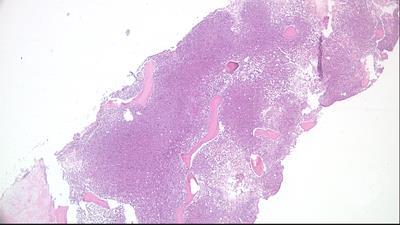
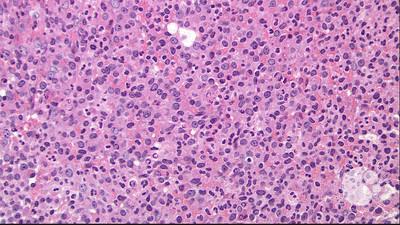
A 73-year-old man with a 7-year history of untreated chronic lymphocytic leukemia (CLL) with mutated IGHV presented with new-onset anemia and thrombocytopenia. Bone marrow was hypercellular (95%) (panel A, hematoxylin and eosin [H&E], 4× objective). In addition to the CLL infiltrate (panel B, PAX5 immunohistochemistry [IHC], 4× objective), it showed increased blasts (panel C, CD34 IHC, 4× objective), decreased granulopoiesis, and dysplastic megakaryocytes (panel D, H&E, 20× objective). A subset of blasts expressed the erythroid marker CD71 (panel E, 20× objective) and the megakaryocytic marker CD61 (panel F, 20× objective). A diagnosis of CLL and acute myeloid leukemia (AML) with erythroid/megakaryocytic differentiation was made. Next-generation sequencing detected multiple mutations, including TP53 (c.745A>G, p.R249G, variant allelic frequency <5%) in a hemodiluted aspirate sample. Fluorescent in situ hybridization showed deletion of TP53 in 10% of the analyzed interphases. p53 (IHC) demonstrated heterogeneous weak-moderate nuclear staining (wild-type pattern) in CLL cells, whereas the AML blasts exhibited diffuse, strong nuclear overexpression (mutant pattern) (panel G, p53 IHC 10× objective).

This case highlights the value of p53 IHC in determining the compartment of origin of TP53 mutations, as it reveals differential p53 expression patterns in the CLL and AML cells. This distinction could not be made by bulk sequencing studies alone and has immediate prognostic and therapeutic implications for both neoplasms.

For additional images, visit the ASH Image Bank, a reference and teaching tool that is continually updated with new atlas and case study images. For more information, visit https://imagebank.hematology.org.

Advertisement intended for health care professionals