

l

Therapy-related AML with MECOM rearrangement, biallelic TP53 inactivation, and striking nuclear abnormalities
#00066573
Author: Zhaodong Xu; Tyler Smith
Category: Myeloid Neoplasms and acute leukemia (WHO 2016) > Myelodysplastic/myeloproliferative neoplasms (MDS/MPN)
Published Date: 07/17/2026
Category: Myeloid Neoplasms and acute leukemia (WHO 2016) > Myelodysplastic/myeloproliferative neoplasms (MDS/MPN)
Published Date: 07/17/2026
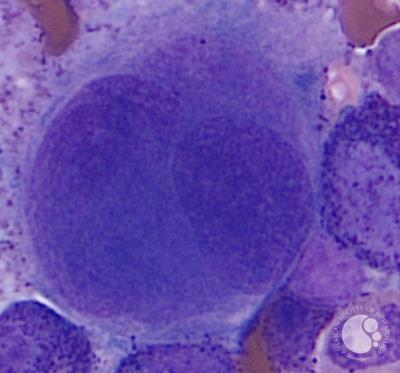
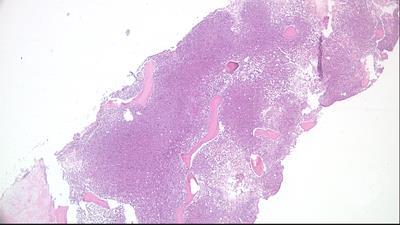
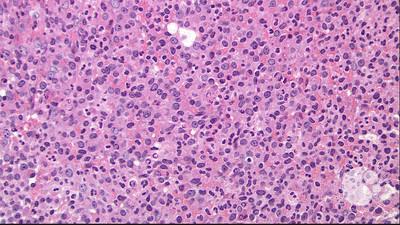
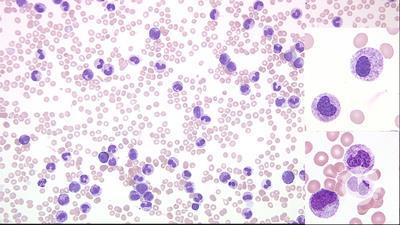
A 62-year-old woman with multiple myeloma (normal karyotype), treated with chemotherapy, autologous stem cell transplantation, and ongoing lenalidomide exposure, presented with circulating blasts. Peripheral blood (PB) showed leukocytes 3.2 × 10⁹/L, neutrophils 0.3 × 10⁹/L, hemoglobin 92 g/L, platelets 145 × 109/L, and 72% blasts. Marrow revealed 48% blasts. PB and aspirate (panels A and B; May-Grünwald Giemsa stain, 100× lens objective) showed undifferentiated-looking blasts, exhibiting marked nuclear abnormalities including nuclear protrusion (red arrow), binucleation (star), micronuclei (thick black arrow), mitotic-figures (thin black arrow), and internuclear-bridging (red curved arrow). Dysplastic megakaryocytes and multinucleated erythroid precursors were present (panels C and D; May-Grünwald Giemsa stain, 100× lens objective). Marrow flow-cytometry illustrated ∼50% blasts expressing CD34+/CD117+/CD13+/partial CD33+/TdT˗/MPO˗ (panel E) with minimal differentiation. Cytogenetics revealed a complex karyotype: 43,XX,˗3,˗7,˗8,˗18,+mar[10]. Optical genome mapping identified a complex genome, including MECOM::RPN1 fusion, monosomy 7, chromothripsis involving chromosome 3 (panel F). Next-generation sequencing identified biallelic TP53 mutations (c.949C>T, p.Gln317Ter [variant allele frequency (VAF): 44.5%]; c.470_473dup, p.Ala159ProfsTer23 [VAF, 37.1%]) and a PTPN11 mutation. A diagnosis of acute myeloid leukemia (AML) with MECOM rearrangement, therapy-related, with biallelic TP53 inactivation was rendered per WHO-HAEM5/ICC (5th edition of the WHO Classification of Haematolymphoid Tumours and the International Consensus Classification) criteria.
The constellation of multilineage nuclear abnormalities suggests marked genomic instability. Minimally differentiated blasts with dysmegakaryopoiesis and dyserythropoiesis are recognized morphologic features of AML with MECOM rearrangement. These findings highlight a rare coexistence of MECOM-associated morphology with TP53-associated genomic instability, raising the possibility that MECOM rearrangement may arise on an unstable genomic background.
For additional images, visit the ASH Image Bank, a reference and teaching tool that is continually updated with new atlas and case study images. For more information, visit


Related Images: